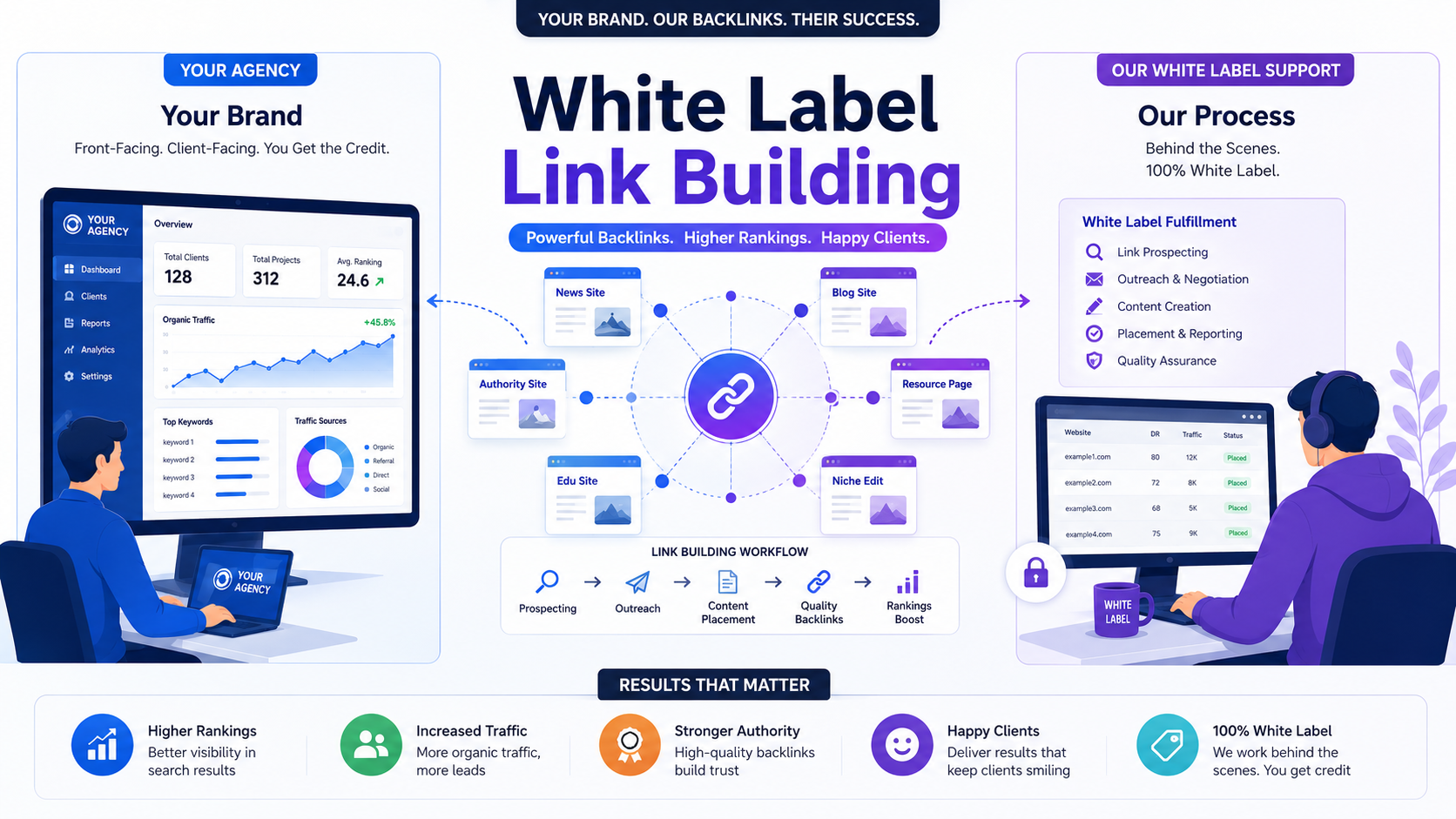
Link building is one of the toughest parts of SEO to deliver well. It takes time, real relationships with website owners, and a team that knows how to land placements that actually help rankings. Most agencies don’t have all three pieces in place, and building them from scratch can take years.That’s where white label link building fits in. It lets your agency offer strong backlink services to clients without hiring an entire outreach team. A specialist partner does the heavy lifting behind the scenes. Your agency delivers the results under your own name.
This guide breaks down what white label link building is, how it works, and how to tell a good provider from a risky one.
What Does White Label Link Building Actually Mean?
White label link building is a setup where an outside company builds backlinks for you, and you pass those links along to your clients as your own work. The client never sees the outside company’s name. They only see your agency’s brand on the report.Think of it like a restaurant that buys bread from a local bakery but serves it as part of its own menu. The customer just sees a great meal from a trusted place. They don’t need to know who baked the bread.
For agencies, the math is simple. You order links at a set price, review them, then bill your client at your own rate. You keep the difference as profit. No hiring, no training, no months spent building a network of website contacts.Agencies turn to white label link building because backlinks remain one of the strongest ranking factors in SEO, yet building them well requires skills many teams simply don’t have in-house.
Why Agencies Choose This Model
Plenty of agencies try to build links on their own first. Many switch to a white label link building setup once they see how much time and money it saves. Here’s why.
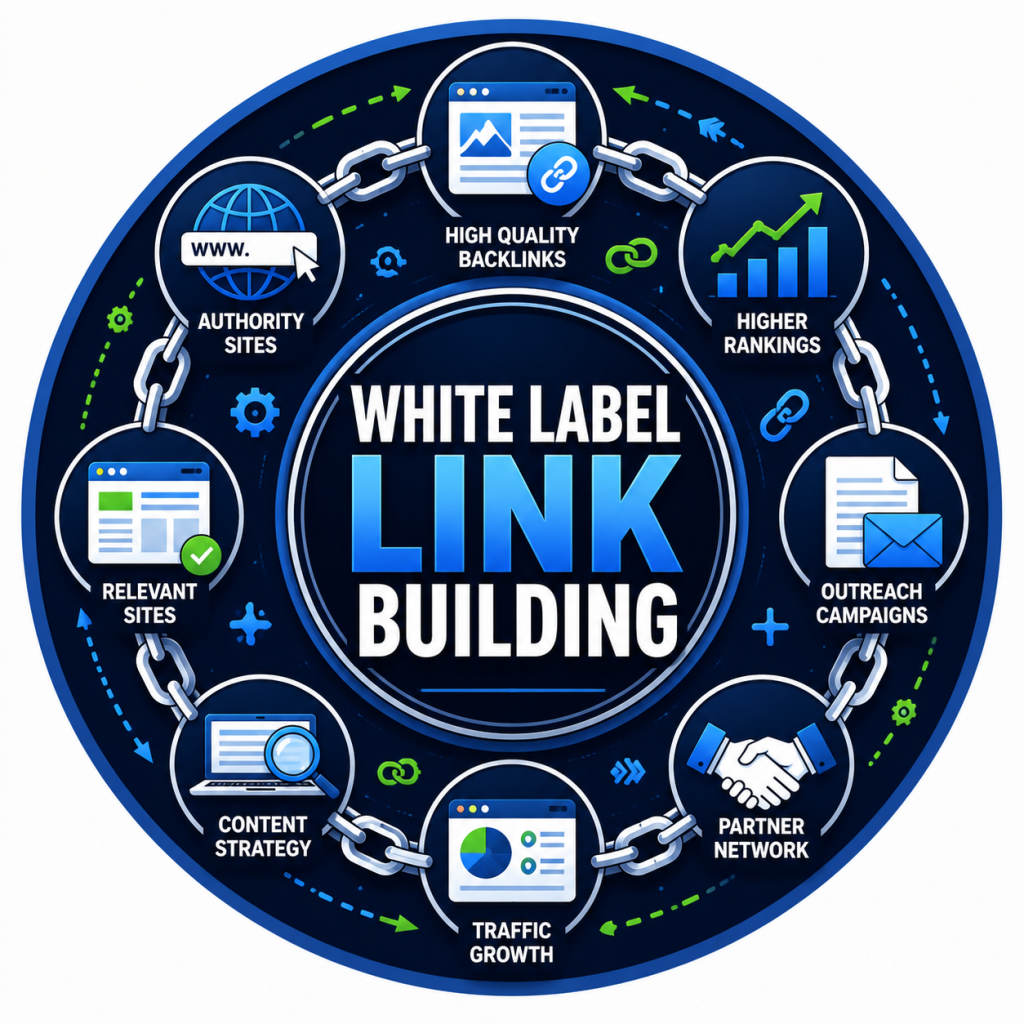
Lower Costs, Bigger Margins
Hiring outreach specialists and content writers adds up fast in salary and training costs. White label link building removes that overhead. You pay per link or per project, and you set your own client pricing on top. This keeps your margins healthy without adding staff to your payroll.
Faster Results for Clients
Building relationships with website owners in a new niche can take months of cold emails and follow-ups. A good white label link building partner already has those relationships. That means your client can start seeing new links within weeks instead of waiting half a year for your team to build a network from zero.
Room to Grow Without Hiring
Winning five new clients shouldn’t mean hiring five new outreach staff. With white label link building, your provider absorbs the extra workload. Your team stays focused on strategy and keeping clients happy, not on chasing down publishers for placements.
A Fuller Service Menu
If your agency mainly handles content or technical SEO, adding white label link building rounds out your offer. Clients like working with one agency for everything. It also means more revenue per client without extra departments to manage.
When Should You Actually Use It?
White label link building isn’t the right call for every agency at every stage. It tends to make the most sense in these situations:
- You’re juggling three or more clients who all need links, and your small team is stretched thin.
- You’re moving into a new industry where you don’t have any contacts yet.
- You want to offer link building but can’t justify hiring a dedicated team right now.
- Your client list is growing faster than your team can keep up with.
- You need steady, predictable output every single month without missed deadlines.
If none of these sound like your agency, building an in-house team might still make more sense for now. But for most growing agencies, outsourcing solves a real bottleneck.
In-House vs. White Label Link Building
Trying to decide between the two? Here’s a side-by-side look at how they stack up.
| Factor | In-House Link Building | White Label Link Building |
|---|---|---|
| Cost | High, due to salaries and training | Lower, pay per link or campaign |
| Speed | Months to build a network | Weeks, since the network already exists |
| Scalability | Limited by team size | Grows easily with client demand |
| Control | Full control over every step | You approve placements, but a partner handles the outreach |
| Risk | Depends entirely on your team’s skill | Depends on picking a trustworthy partner |
Both paths can work well. In-house gives you tighter control over daily execution. White label link building gives you speed and flexibility without the staffing headache. Many agencies actually use a mix of both as they grow.
Watch Out for These Link Building Scams
Not every provider plays fair. Since link quality directly affects your client’s rankings, picking the wrong partner can do real damage. Here are the red flags to know before you sign up for any white label link building service.
Private blog networks (PBNs). These are groups of websites built only to sell links. Google actively hunts for these networks and penalizes sites linked to them.
Link farms. These look like normal websites but exist purely to host paid links. They rarely bring any real traffic or trust.
Low-value directory and forum links. These links won’t usually hurt a site, but they also won’t help much. Paying for them is often a waste of budget.
Fake guest posts. Some services place articles on low-quality sites just to say they “did guest posting.” The placements carry little to no ranking value.
Providers with no proof. If a company promises big results but can’t show real case studies or client examples, that’s a warning sign worth taking seriously.
A trustworthy white label link building partner builds links through genuine outreach and real relationships, not shortcuts that put your client’s site at risk.
How to Pick a Reliable Provider
Choosing the right partner for white label link building matters more than almost any other part of the process. Here’s what to check before you commit.
Ask About Site Approval
You should get to review every target website before outreach starts. If a provider won’t let you see or approve their site list, that’s usually a sign they’re working from a fixed, low-quality inventory.
Look Past Domain Rating Alone
A site with a high domain rating but almost no visitors isn’t worth much. Ask providers how they check for real, active readership, not just a flashy metric.
Confirm the Outreach Is Manual
Genuine, one-on-one outreach builds links that last. Automated blasts or bulk email campaigns often result in weak, spammy placements that can hurt more than help.
Check Their Anchor Text Approach
Using the same keyword-rich anchor text over and over can trigger a Google penalty. A solid provider will vary anchor text naturally based on your client’s existing backlink profile.
Ask About Guarantees
Reliable providers often offer a replacement guarantee, usually around 12 months, in case a link goes down. This protects your investment and your client relationship.
What Kinds of Links Can a Provider Deliver?
A strong white label link building partner should offer more than a single type of placement. Here are the most common options you’ll come across.
Guest posts. Full articles written for other websites with a natural link back to your client’s page. These form the backbone of most campaigns.
Editorial links. Links added into existing articles on established websites. These tend to feel more natural to readers and often carry solid ranking value.
Digital PR placements. Coverage earned through newsworthy stories, original research, or expert quotes. These links usually come from bigger media sites and are harder to copy.
HARO and journalist outreach. Your client gets quoted by a reporter, earning a link from a trusted publication. These links carry strong trust signals since editors choose to include them.
Niche edits. Links added to already-published, indexed content on relevant sites. Because the page already has some authority, results can show up faster.
The strongest campaigns mix a few of these link types together. A provider that only offers one type of link probably isn’t giving your client a well-rounded backlink profile.
A Simple Process to Follow
Most reliable white label link building providers follow a process similar to this one.
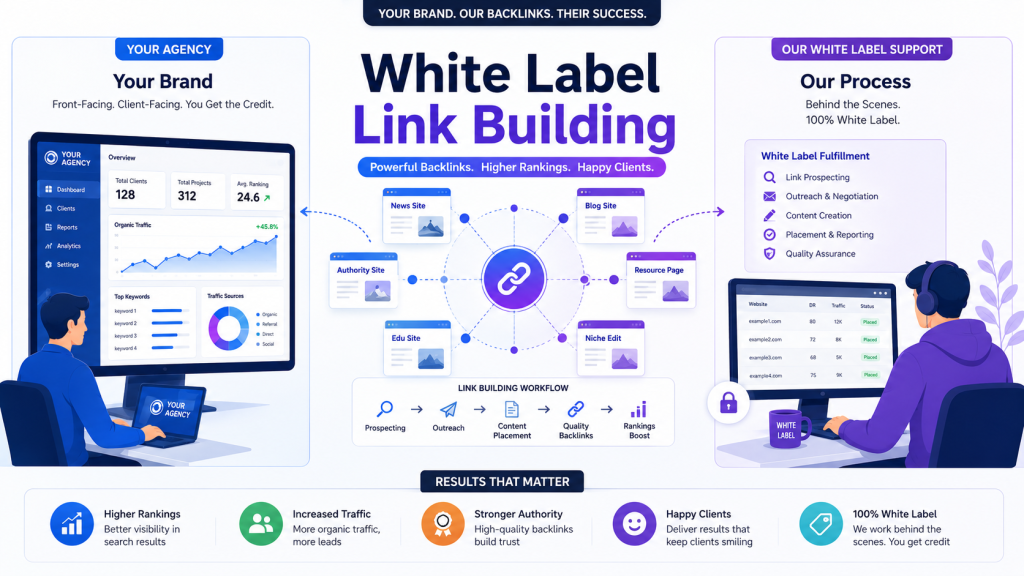
- Order. You choose how many links you need and which pages should receive them.
- Research. The provider studies your client’s site, competitors, and existing content to find the best opportunities.
- Strategy. A plan comes together based on the client’s niche and goals, mixing guest posts, editorial links, or other tactics.
- Outreach. The team builds a list of target sites and reaches out with a personalized pitch, not a generic mass email.
- Relationship building. Trust gets built with site owners over time, which often opens doors to better, long-term placements.
- Reporting. Links go live, and you receive a clear, unbranded report you can hand straight to your client.
This structure keeps everything transparent, so you always know what your client is paying for.
Common Questions About White Label Link Building
Is link building still worth it in 2026?
Yes. Backlinks remain one of Google’s strongest ranking signals, and that hasn’t changed much over the years. What has changed is that quality now matters far more than quantity, so a handful of strong links usually beats dozens of weak ones.
How long does it take to see results?
Most agencies see the first links go live within a few weeks of starting. Full results, like ranking improvements, usually take a few months since Google needs time to process new links and adjust rankings.
Can one provider handle several clients at once?
Yes, most established providers manage dozens of clients across many niches at the same time. A good outreach team scales its capacity without lowering quality, so your agency can keep adding clients with confidence.
What does white label link building typically cost?
Pricing varies based on the number of links, the authority of the target sites, and the client’s niche. Most providers offer package pricing, so it’s easy to compare monthly costs before choosing a plan.
What’s the biggest risk with outsourcing links?
The main risk is ending up with a provider that cuts corners using PBNs or low-quality sites. Always ask for site examples and check that outreach is done manually before signing any contract.
Wrapping It Up
White label link building gives agencies a practical way to offer strong backlink services without building an outreach team from the ground up. It lowers costs, speeds up delivery, and lets your agency scale without adding headcount every time a new client signs on.
The key is picking a provider you trust. Look for site approval, manual outreach, fair anchor text practices, and clear reporting. Do that, and white label link building becomes one of the easiest ways to grow your agency’s services while keeping your clients happy with real, lasting results.